read all about it
Thin repair layers starting at 30 mm: how solidian ANTICRACK changes the layer structure
Reprofiling layers on floors, parking decks and industrial surfaces are usually installed without reinforcement. For a long time, this was the only practicable option — not because reinforcement was not needed, but because it was not possible. solidian ANTICRACK changes that.
No reinforcement option for thin reprofiling layers until now
When reprofiling industrial floors, parking decks and other trafficked surfaces, repair mortar layers are generally left unreinforced. This is not an oversight. Until now, it was the unavoidable consequence of a simple geometric limitation.
Thin reprofiling layers do not provide enough space for reinforcement systems that require a defined minimum cover to ensure their own durability. Layer thicknesses of 30 to 50 mm were effectively impossible to reinforce with such materials. The mortar layer remained unreinforced — and therefore structurally vulnerable to tensile stresses that it cannot control on its own.
What carbon makes possible as a reinforcement material
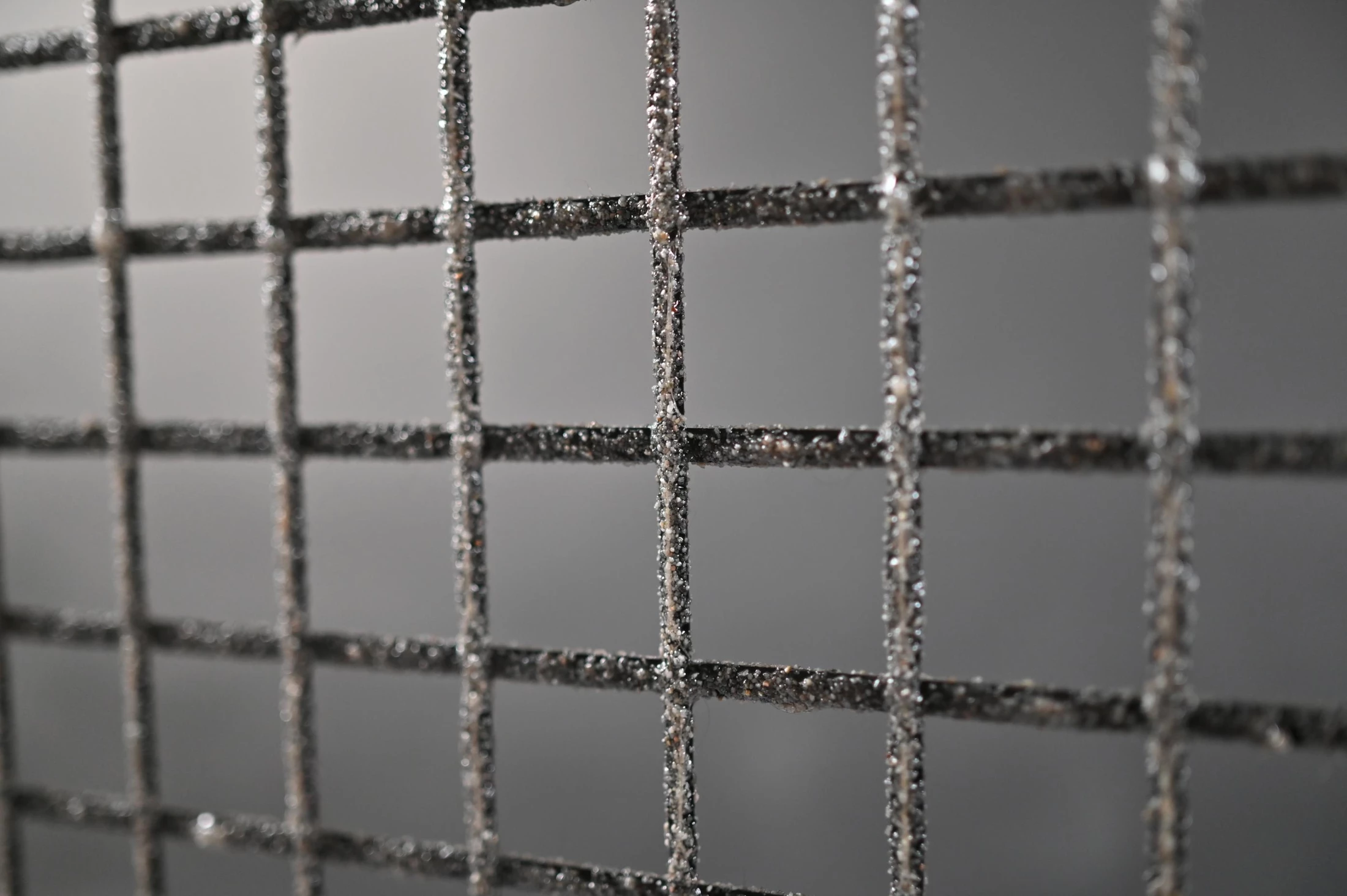
The carbon material of solidian ANTICRACK Q85-CCE-21 is inert. It does not react with chlorides, it does not carbonate, and it does not corrode. A protective minimum cover is not required.
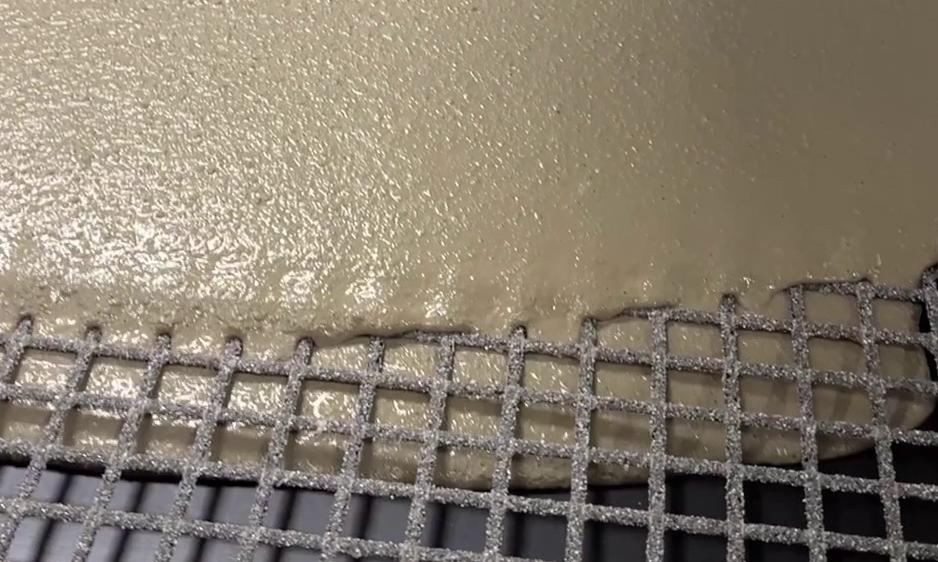
This is the decisive difference: the grid can be installed close to the surface — exactly where tensile stresses are highest in thin layers (→ Part 1) — without increasing the layer thickness in order to protect the reinforcement permanently. The layer structure is determined solely by the technical requirements for the reinforcement effect. This makes reinforcement possible in layers that, until now, could not be reinforced from a construction point of view.
System layer thicknesses starting at 30 mm — a practical planning dimension
Because carbon is corrosion-free, system layer thicknesses starting at 30 mm are feasible. This is not a theoretical limit. It is a planning-relevant dimension for repairs on:
• parking decks, where build-up heights are limited by vehicle clearance heights, drainage slopes and expansion joint transitions
• industrial floors with defined level requirements for machines, transitions, docking areas and transport routes
• repair areas in existing structures, where door thresholds, stair transitions and structural connections restrict the available construction height
In each of these applications, a reduced layer build-up is a real planning advantage — both technically and economically.
What thinner layers mean for operators
Lower additional load. Repair mortar has a significant bulk density. Every centimetre of layer thickness saved noticeably reduces the surface weight — relevant for slab structures with limited reserve load-bearing capacity or for repair concepts intended to avoid structural strengthening.
No height adjustments. Thicker build-ups often require adjustments to doors, thresholds, drainage channels and expansion joint transitions. With 30 mm, this can be avoided in many cases.
Shorter interruption of use. Less material means less installation and curing time — and therefore earlier reopening of the surface.
The solidian CARGO system — efficient reinforcement for large areas
For large-scale repairs, the solidian CARGO system is available. solidian ANTICRACK can be supplied as roll material in lengths of up to 115 m and a width of 2.30 m — one roll reinforces up to 260 m² with virtually no joints.
The CARGO system enables fast installation directly from the roll. With a weight of less than 1 kg/m², handling on site is significantly simplified — even on large or difficult-to-access areas. Cutting and adapting the reinforcement to different component geometries is possible without special tools.
As an individual grid measuring 6.0 m × 2.30 m, the reinforcement is also available for smaller areas and geometrically demanding sections.
What follows
Thin layer structures create the necessary construction conditions. Whether crack-width limitation in the specific system build-up achieves the planned effect can be quantified with solidian ANTICRACK on the basis of test data — and can therefore be verified for planning purposes.
Ready to discuss your project?
To support planners, we offer an extensive planning center with relevant documents and a structural dimensioning tool. If you are evaluating reinforcement options for a specific repair project, our technical team can help review the relevant parameters and documentation.