read all about it
As part of an experimental urban furniture project in Chemnitz, a sculptural concrete seating element in the shape of a “C” was realized using carbon-reinforced concrete. The project was initiated and executed in collaboration with Medicke, who manufactured the concrete element and integrated carbon reinforcement into the prefabricated component.
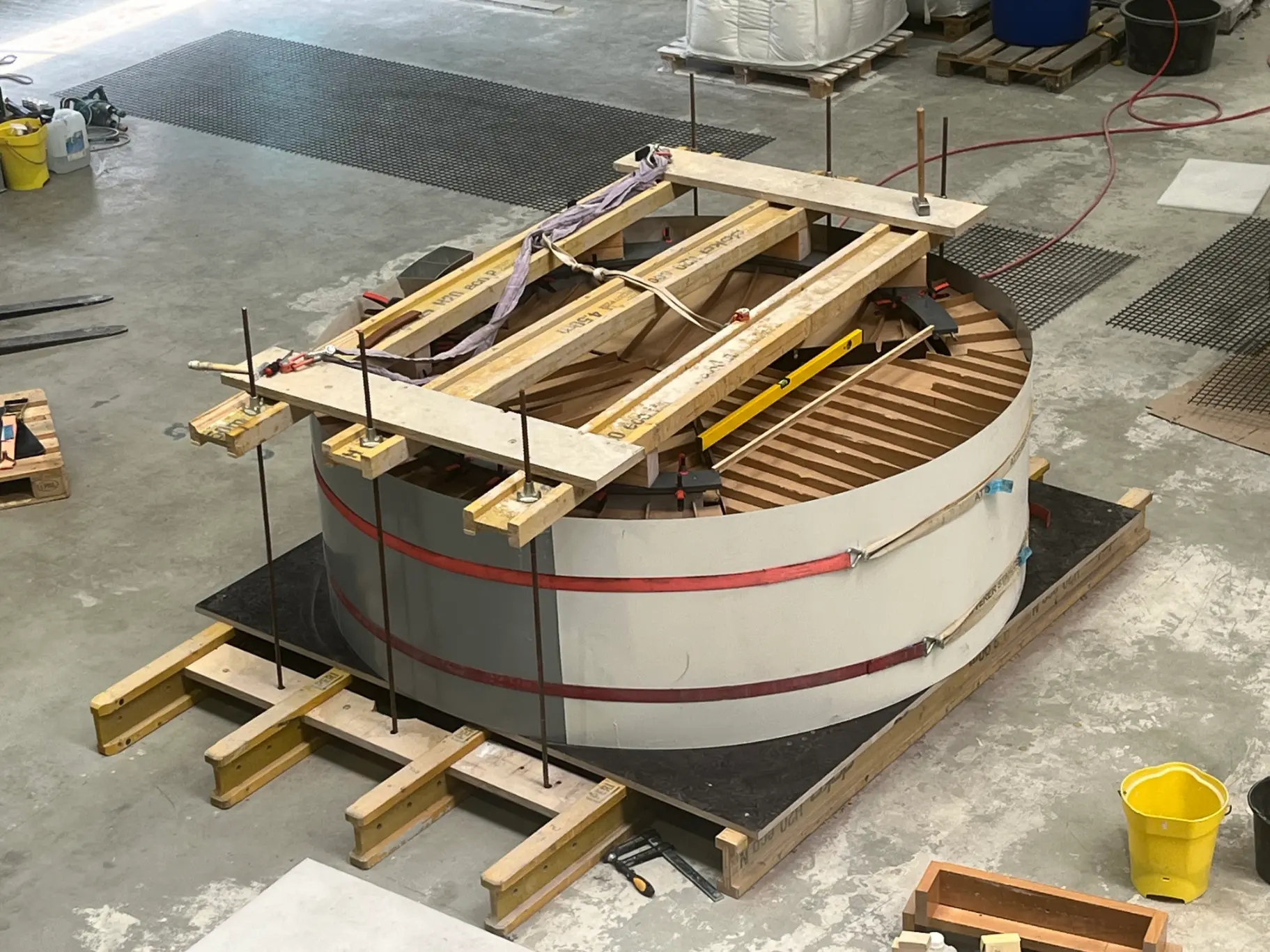
Research and development support was provided by the Technische Universität Chemnitz, while the recyclable cardboard formwork was developed together with Richter & Heß Verpackungen.
Reinforcement Concept
For the concrete structure, solidian GRID Carbon was used as internal, non-corrosive reinforcement.
Carbon reinforcement enables the realization of slender concrete elements while ensuring high durability. Due to the non-corrosive nature of the material, reduced concrete cover can be implemented safely from a structural perspective.
For demanding exposed concrete surfaces, specially developed spacers are used. These are specifically designed for carbon grids and ensure precise and reproducible positioning of the reinforcement.
This makes carbon reinforcement particularly suitable for curved and visible concrete elements with high requirements in terms of durability and surface quality.
Special Project Aspects
A distinctive aspect of the project was the use of a recyclable cardboard formwork system tailored specifically to the geometry of the seating element.
In combination with carbon reinforcement, this approach enabled an efficient production process with very low material and resource input, making it suitable for one-off elements and experimental applications.
Result
The finished seating element demonstrates how carbon-reinforced concrete can be applied in prefabrication to realize expressive architectural forms with reduced material thickness and long-term durability.
The reinforcement does not imprint on the concrete surface, underlining the suitability of textile reinforcement for high-quality architectural concrete applications.
Project data
| Application | Urban Furniture / Architectural Concrete |
| Object | Single seating element (C-shaped) |
| Location | Chemnitz, Germany |
| Product | solidian GRID Carbon |
| Manufacturing partner | Medicke GmbH |
| R&D partner | Technische Universität Chemnitz |
| Formwork partner | Richter & Heß Verpackungen |