read all about it
Looking beyond initial costs
The initial investment required for a concrete repair using carbon reinforcement may be higher than for a comparable solution based on conventional steel reinforcement. This should be transparently considered during design, specification and economic evaluation.
However, a meaningful assessment should not be based solely on material or initial construction costs. Instead, it should take into account the costs incurred over the entire service life of the structure.
From this perspective, the key question is not simply which reinforcement has the lowest initial cost. Rather, it is which repair concept is best suited, under the given project conditions, to minimise future maintenance requirements and their associated operational impacts over the long term.
Particularly in chloride-exposed structures, the costs of a repair rarely consist only of materials and installation. They also include site access, traffic management, labour, operational restrictions, closures, inspections, future repair interventions and the renewal of surface protection systems.
Against this background, selecting reinforcement that is not susceptible to the corrosion mechanisms that typically affect steel reinforcement in chloride environments may have a significant influence on the long-term life cycle assessment of a structure.
Evaluating performance over the service life
Reinforced concrete structures exposed to chlorides often require recurring maintenance and repair interventions throughout their service life. The extent and timing of these interventions depend on numerous factors, including environmental exposure, structural design, workmanship and operating conditions.
Each intervention generates both direct and indirect costs, ranging from routine inspections and local repairs to major rehabilitation works or even the replacement of structural components.
Carbon reinforcement itself is not susceptible to chloride-induced corrosion. Where it replaces corrosion-prone steel reinforcement, this particular deterioration mechanism no longer affects the newly installed reinforcement.
Whether and to what extent this results in economic benefits depends on the specific structure and the selected assessment period. Over sufficiently long service lives, higher initial investment costs may be partially or fully offset by reduced maintenance requirements and lower operational disruption.
The durability and life cycle assessment documentation provided by solidian & kelteks is intended to illustrate these relationships through technical scenarios and project-based evaluations.
The owner's perspective
The assessment of life cycle costs varies depending on the stakeholder's perspective.
For structural engineers, it represents a technical and economic evaluation of a repair concept. For owners and infrastructure operators, the practical question is often:
How frequently will this structure require future repair interventions, and what operational consequences will those interventions have?
Operators of parking structures are familiar with the economic impact of closed parking levels and reduced capacity. Bridge owners must deal with traffic management measures and restrictions on use. Municipalities and infrastructure operators are regularly required to plan and finance maintenance programmes over extended periods.
From this perspective, a repair concept that improves the durability of the repaired areas and reduces or delays future interventions may provide economic advantages. The actual benefits, however, should always be assessed on a project-specific basis.
In this context, carbon reinforcement is not presented as an inherently lower-cost material. Rather, depending on the specific project conditions, it can contribute to optimising long-term life cycle costs.
The importance of crack behaviour for the overall system
Life cycle considerations extend beyond the structural element itself. The interaction between the repair layer, the reinforcement and the surface protection system can also influence long-term durability and future maintenance requirements.
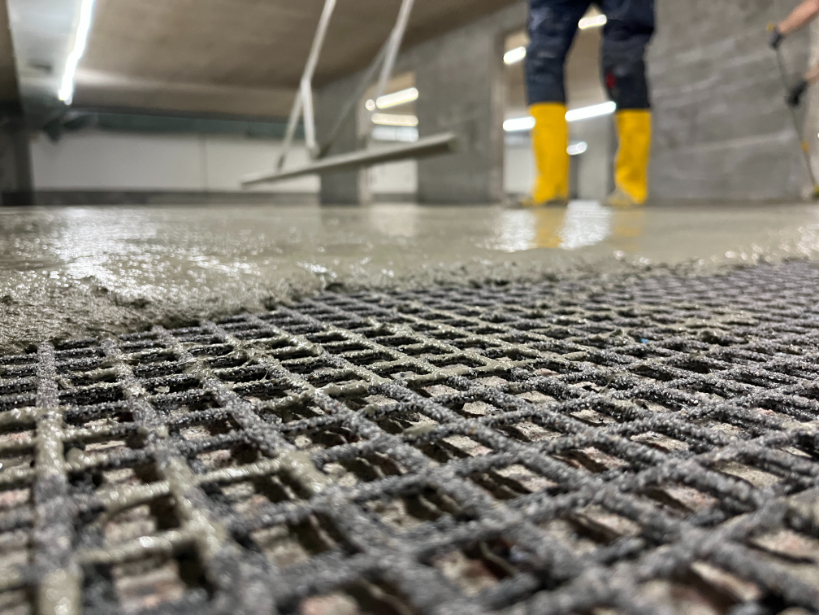
solidian ANTICRACK has been specifically developed for applications where crack width control and crack distribution are key design considerations. Its sand-coated surface provides excellent mechanical bond with suitable repair mortars.
The interaction between reinforcement, bond characteristics and repair mortar can contribute to a more favourable crack distribution and effective crack width control within the repair layer.
In turn, controlled crack behaviour may influence the requirements placed on the overall system consisting of repair mortar and surface protection. The selection of the appropriate surface protection system should always be based on the specific project conditions and the applicable technical standards.
For this reason, repair mortar, reinforcement layout, crack width control and surface protection should always be considered together as part of an integrated repair concept.
Incorporating life cycle considerations into the planning phase
For projects in which life cycle costs form part of procurement, economic evaluation or investment decisions, technical documentation on durability together with Environmental Product Declarations (EPDs) can provide an important basis for assessment.
These documents can help broaden the discussion from initial construction costs to total operating costs, maintenance intervals, maintenance planning and long-term durability at an early stage of project development.
Depending on the technical objectives of the project, the evaluation may include both concrete repair measures and load-bearing structural strengthening. For such applications, approved strengthening systems such as CARBOrefit® may also form part of the overall technical assessment, subject to the specific project requirements and the applicable technical approvals.
Particularly where life cycle cost considerations are to be incorporated into the planning process, early technical coordination between the owner, the design team and the involved system partners is recommended.
Recommended documentation for lifecycle evaluation
Depending on the specific project requirements, the following documents may be relevant for technical evaluation and life cycle assessment:
- Carbon reinforced concrete - 100 years of durability
- Environmental Product Declaration (EPD) for solidian GRID and solidian REBAR
- Environmental Product Declaration (EPD) for solidian ANTICRACK
- solidian PARKING DECKS flyer
- solidian Restoration flyer
- solidian ANTICRACK technical product data sheet
The documents relevant to a particular project should always be determined on the basis of the specific application and the applicable technical and regulatory framework.
Ready to discuss your project?
To support planners, we offer an extensive planning center with relevant documents and a structural dimensioning tool. If you are evaluating reinforcement options for a specific repair project, our technical team can help review the relevant parameters and documentation.