read all about it
Repaired surfaces often crack again. This is not always caused by the mortar itself. In many cases, the new layer simply has no way to absorb and transfer tensile stresses in a controlled manner. This is exactly where solidian ANTICRACK comes in - as non-metallic carbon reinforcement within the repair mortar layer.
Why repair layers crack
A fresh mortar layer shrinks as it hardens. At the same time, it is bonded to the substrate and therefore cannot deform freely. This restrained deformation creates restraint stresses. Thermal effects caused by temperature changes and mechanical loads from use add further stress.
As soon as the resulting tensile stresses exceed the tensile strength of the mortar, the layer cracks. Without reinforcement, this deformation is concentrated in one or a few wide cracks. The consequences are direct: subsequent coatings may fail, moisture can penetrate into the substrate, and the repair loses its intended effect.
Floors, parking decks and industrial surfaces are particularly vulnerable because they are exposed to mechanical loads, vibrations and temperature extremes at the same time.
The working principle - bond enables force transfer
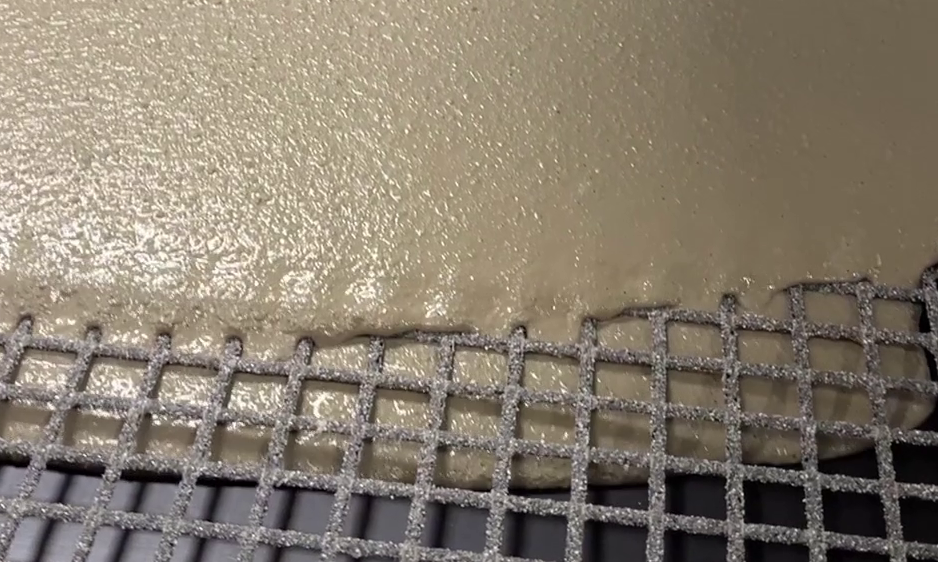
solidian ANTICRACK Q85-CCE-21 is a symmetrical, bidirectional carbon reinforcement grid made of media-resistant carbon fiber composite material. The surface of the grid is sanded.
This sanded surface is the key technical element. A suitable repair mortar fully surrounds the grid and creates an intensive mechanical interlock. Through this interlock, tensile stresses from the mortar layer are efficiently transferred into the carbon reinforcement - bidirectionally, in both grid directions.
Short anchorage lengths are sufficient for high force transfer with minimal embedment. The sanded surface provides the necessary bonding area.
From one wide crack to many small ones
Without reinforcement, tensile stress is released in a single wide crack. With solidian ANTICRACK, the grid distributes the strain across many smaller individual cracks. The energy of the tensile stress is not concentrated in one place, but spatially distributed through the reinforcement.
The result is effective crack-width limitation. Individual wide cracks that could endanger subsequent coatings and allow moisture to pass through can be avoided. The repair layer behaves in a more controlled way under tensile stress.
Cracking is therefore not generally excluded - but it becomes technically controllable.
Why the reinforcement is positioned close to the surface
In thin layers applied onto a substrate, the highest tensile stresses occur close to the surface. This is exactly where the reinforcement must be positioned in order to be effective.
Carbon reinforcement does not require a protective concrete cover against corrosion. The inert carbon material is completely resistant to chlorides and carbonation. Without the limitation of a minimum cover requirement, the grid can be installed where it is technically most effective: directly below the surface.
What this property specifically enables for the layer structure is covered in Part 2 of this series.
Targeted debonding at still-active cracks
Surfaces with existing cracks that continue to move under use present a particular challenge. A repair layer applied to such a substrate is stressed by the ongoing movement - with the risk of a continuous crack forming in the new layer.
solidian ANTICRACK offers a technical detail solution for this situation: through targeted debonding of the substrate in the immediate area of the crack, a defined free elongation length is created. The crack movement is then distributed across several small individual cracks in the mortar layer - controlled instead of uncontrolled.
This is particularly relevant for floors and slabs where crack movement in the existing structure cannot be fully prevented - a situation frequently encountered in practice.
What follows
The working principle of solidian ANTICRACK results from the interaction of the sanded surface, mechanical interlock and bidirectional reinforcement. The mortar layer restores the surface - solidian ANTICRACK gives it the ability to absorb tensile stresses and distribute them in a controlled way.
Ready to discuss your project?
To support planners, we offer an extensive planning center with relevant documents and a structural dimensioning tool. If you are evaluating reinforcement options for a specific repair project, our technical team can help review the relevant parameters and documentation.