read all about it
The honest version of the cost comparison
The initial cost of a repair using carbon reinforcement is higher than a conventional steel-based solution. That is a straightforward fact, and any planner or engineer who specifies it needs to be able to justify it to their client, to their project controller, and in writing.
The justification is a lifecycle argument, not a product preference. It depends on accepting that the relevant cost comparison is not between one repair and another. It is between one repair and the total number of repairs that will be needed over the structure's service life, and the operational disruption each one causes.
The relevant question is therefore not: which reinforcement has the lowest initial material cost? The relevant question is: which repair concept reduces the probability, frequency and impact of future interventions?
In chloride-exposed structures, the cost of repair is rarely limited to the repair material itself. It includes access, preparation, labour, traffic management, closed parking levels, reduced operational capacity, inspection cycles and future surface protection replacement. A reinforcement solution that removes the corrosion mechanism from the repaired zone can therefore create value even when the initial repair cost is higher.
How the comparison works
Steel-reinforced concrete in chloride-exposed environments follows a predictable pattern. Initial construction or repair. Gradual chloride ingress. Onset of corrosion. Crack formation and spalling. Repair. Repeat.
Each phase of this cycle generates costs: routine maintenance, inspection, major repair works, and eventually, in severe cases, partial or complete replacement of structural elements.
Carbon reinforcement removes the corrosion mechanism from the equation. In the repaired zone, chlorides and de-icing salts cannot initiate the same damage sequence in the carbon reinforcement. The material is not affected by the environment that drove the original corrosion damage.
Our Durability100Years presentation compares these lifecycle trajectories directly, showing maintenance intervals, major renovation cost events, and CO₂ emission profiles over the building lifetime for carbon-reinforced concrete versus conventional steel-reinforced construction.
The conclusion of that comparison is not that carbon concrete is cheaper to build. It is that the initially higher cost can be offset, and over a sufficiently long service horizon more than offset, by avoiding repeated repair cycles and the costs they carry.
The operator's perspective
This argument lands differently depending on who is making the decision. For a structural engineer, it is a technical and economic analysis. For an asset owner or infrastructure manager, it is a question of operational exposure: how many times, and at what cost, will this structure interrupt operations for repair works over the next 30, 50, or 100 years?
Parking garage operators know the economics of closed levels. Bridge authorities know the cost of traffic management during repair works. Municipal infrastructure managers know the budget pressure of recurring maintenance programmes. For all of these groups, a repair approach that removes the primary damage mechanism from the repaired zone, and extends the interval before the next major intervention, has a value that can be calculated, even if it is not always calculated at the point of specification.
This is where the lifecycle argument becomes commercial, not only technical. A parking garage operator does not only pay for concrete repair. The operator pays for closed levels, reduced capacity, customer inconvenience and future maintenance planning. A bridge authority does not only pay for materials and labour. It also pays for traffic management, public disruption and repeated budget allocation.
In this context, corrosion-free reinforcement is not positioned as a cheaper material. It is positioned as a way to reduce the risk of paying for the same damage mechanism again.
The surface protection dimension
The lifecycle argument applies not only at the structural level but also at the surface protection level. Reinforcement choice affects crack behaviour in the repair layer, and crack behaviour affects the type and long-term performance of the surface protection system above.
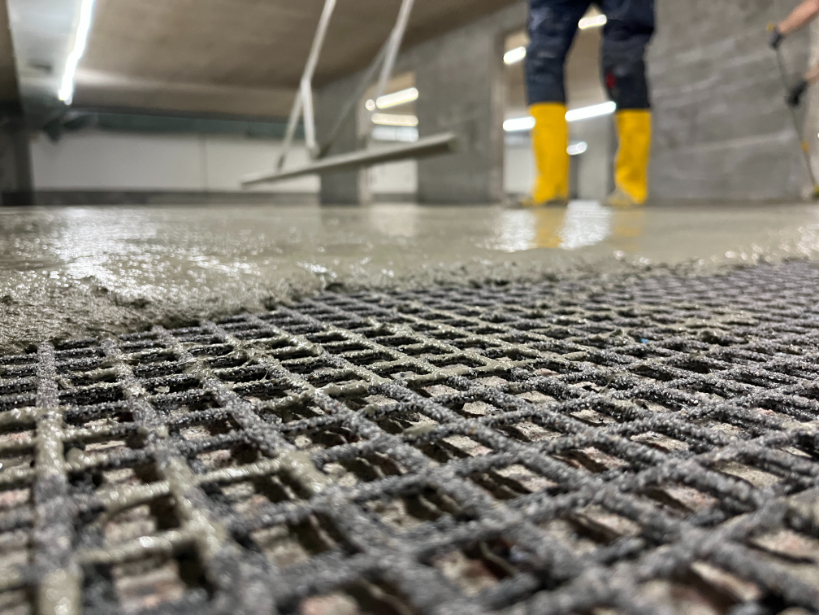
With solidian ANTICRACK as near-surface reinforcement, crack widths in the repair layer can be controlled more directly. Smaller and more evenly distributed crack widths can reduce the demands placed on the surface protection system.
With sufficiently tight crack widths in the repair layer, a rigid OS8 surface protection system may be adequate. Without that crack control, flexible crack-bridging systems such as OS10 to OS14 may be required instead. Rigid systems are mechanically more resistant and do not require the periodic membrane replacement that flexible systems need.
The final system selection must always be verified project by project. Repair mortar, reinforcement layout, crack-width limitation and surface protection system have to be considered together. For the operator, the potential result is less disruption, less material consumption and more predictable maintenance planning.
Planning with lifecycle data
For projects where lifecycle cost comparison needs to be formalised in tenders, value-for-money assessments or client presentations, solidian & kelteks provides supporting documentation including the Durability100Years presentation and certified Environmental Product Declarations (EPDs) for selected reinforcement products.
These documents allow lifecycle assessment to be integrated into the planning stage, rather than being estimated retrospectively. They help shift the discussion from initial material cost to total cost of ownership, repair intervals, maintenance planning and long-term durability.
If you are working on a project where the lifecycle cost argument is relevant to the specification decision, the solidian & kelteks technical team is available to support that discussion.
Recommended documents for lifecycle evaluation
For lifecycle cost discussions, client presentations and project justification, the following documents are especially relevant:
- Carbon reinforced concrete - 100 years of durability
- Environmental Product Declaration (EPD) for solidian GRID and solidian REBAR
- Environmental Product Declaration (EPD) for solidian ANTICRACK
- solidian PARKING DECKS flyer
- solidian Restoration flyer
- solidian ANTICRACK technical product data sheet
Ready to discuss your project?
To support planners and engineers, we offer an extensive planning center with relevant documents and a structural design tool. If you are evaluating reinforcement options for a specific repair or strengthening project, our technical team can help review the relevant parameters and documentation.